
Setup and Tutorials
How to Choose USB or Bluetooth for Your First HarnessKeys Session
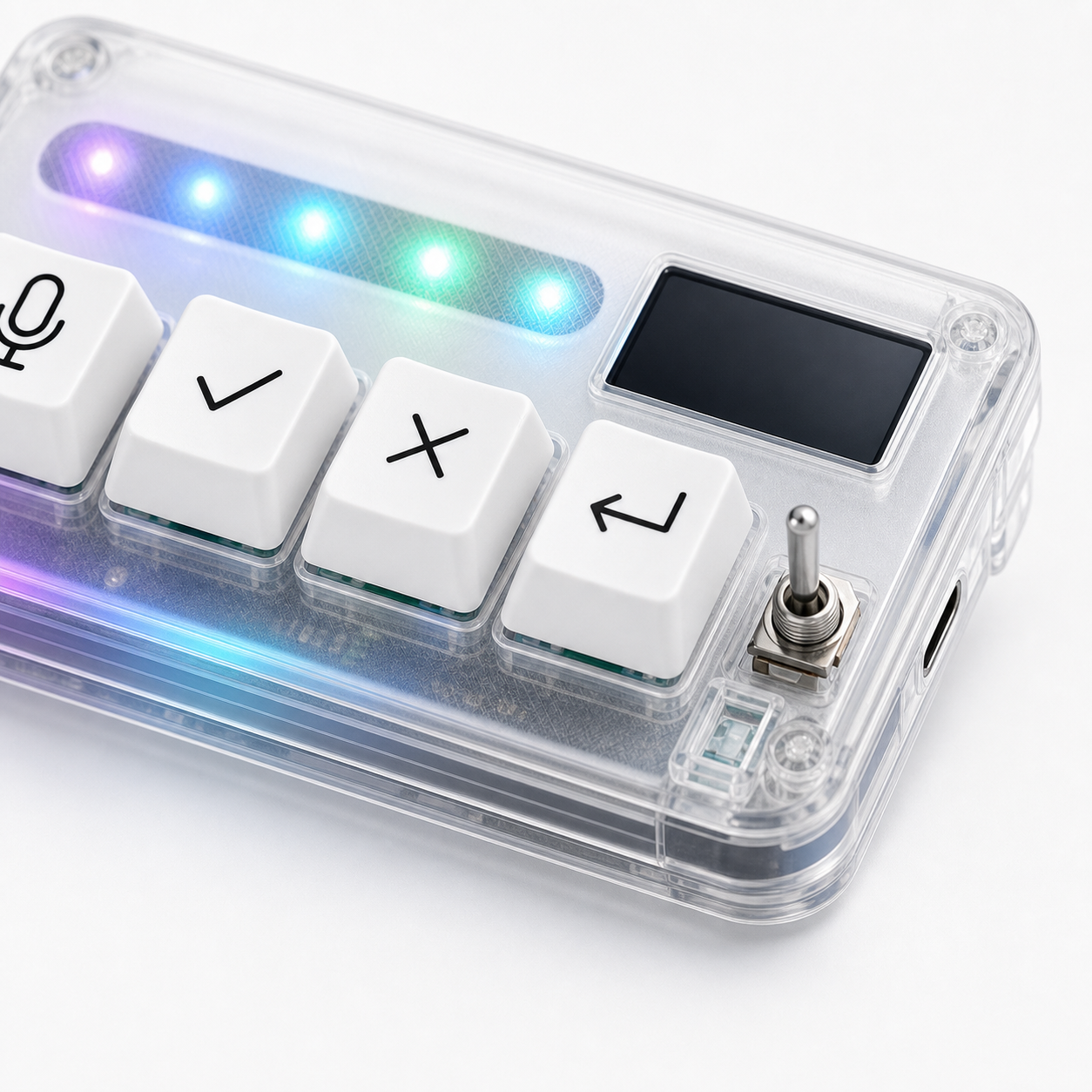
Jun
The USB or Bluetooth choice is less about which mode is “better” and more about what kind of first session you want. HarnessKeys can fit different desk styles, but a new user should not start by optimizing for elegance. Start by optimizing for a reliable test.
If the first session works, you can refine the setup later. If the first session is confusing, it is hard to know whether the issue is the keypad, the operating system, Bluetooth pairing, app permissions, or your AI tool. That is why connection mode deserves a simple decision process.
Use USB when you want the cleanest first proof
USB is usually the best first test for a new hardware controller. It gives the computer a direct connection and removes several wireless variables. You can plug in, open a text field, press keys, and quickly learn whether the device is registering input.
This does not mean USB is always better for daily use. It simply makes troubleshooting easier during the first session. If a key does not work over USB, you know to check the cable, port, operating system recognition, or mapping. You are not also wondering whether Bluetooth paired correctly.
For a first HarnessKeys setup checklist, USB is the practical default.
Use Bluetooth when desk freedom matters more
Bluetooth makes sense when your desk is cable-sensitive, your laptop moves around, or you want the keypad to sit in a position where a cable would be annoying. It can also feel cleaner in a minimal setup where the main keyboard and mouse are already wireless.
The trade-off is that Bluetooth adds pairing behavior, battery awareness if relevant, interference possibilities, and operating system device management. None of those are unusual, but they can complicate the first five minutes.
If you choose Bluetooth first, pair it calmly, confirm the device appears in system settings, then test keys in a plain text field before opening an AI coding tool.
Do not confuse connection problems with mapping problems
A connection problem means the computer is not receiving input from HarnessKeys reliably. A mapping problem means the device sends input, but the action is not what you expected in your software. These are different issues, and mixing them up wastes time.
Test connection first. Open a simple text field and press each key. If the computer receives something, the connection is at least partly working. Then test the mapping inside your intended workflow: voice input, approve, cancel, return, or whichever shortcut you assigned.
If the simple text test works but the AI tool does not respond, investigate permissions, app focus, shortcut conflicts, or the AI tool’s own settings.
USB is better for debugging shortcut conflicts
When a shortcut does not behave as expected, USB can make debugging calmer because the connection layer is stable. You can focus on whether the active app accepts the shortcut, whether another program intercepts it, or whether the operating system uses the same combination for something else.
This matters for voice input. A mic key may need to trigger dictation, push-to-talk, browser voice input, or a specific AI assistant control. If permissions are blocked, the key can appear broken even though it is sending the right signal.
USB does not solve permission issues, but it narrows the problem.
Bluetooth is better for flexible laptop setups
If you use HarnessKeys with a laptop that moves between rooms, Bluetooth can be the more natural daily mode. You can place the keypad beside the laptop, next to a trackpad, or near an external keyboard without threading another cable through the setup.
For people who code from a dining table, coworking desk, or temporary office, this flexibility can matter more than the absolute simplest connection path. The point of a vibe coding keyboard is to lower friction. If a cable creates friction every time you move, Bluetooth may be the better long-term choice.
Just do the first pairing carefully and test before serious work.
Switching modes should be deliberate
Do not switch between USB and Bluetooth repeatedly during the same troubleshooting moment unless you are intentionally testing. Switching too often can create false clues. You may fix one issue and create another without realizing which change mattered.
Pick one mode, test it, write down what happened, then switch if needed. If USB works and Bluetooth does not, the device may be fine while pairing or system settings need attention. If Bluetooth works and USB does not, check the cable, port, hub, and operating system recognition.
Simple notes beat guessing.
Consider latency, reliability, and desk feel
For most basic control actions, the practical difference between USB and Bluetooth is less about raw speed and more about trust. Do you trust the key press to register when you need to cancel an AI action? Do you trust voice input to start when you press the mic key? Do you trust approve to work without thinking?
If one mode feels more reliable on your machine, use it. A beautiful cable-free desk is not worth much if you hesitate before every key press. On the other hand, a clean wireless setup can be excellent if it works consistently.
Your desk is the test lab.
A good first-session recommendation
Start with USB if you are new to HarnessKeys, new to hardware keypads, or setting up a serious AI coding workflow for the first time. Once the keys, mappings, and app permissions are proven, try Bluetooth if you want a cleaner desk.
Start with Bluetooth if your main pain is cable clutter and you are comfortable pairing devices, checking system settings, and doing a slower first test.
Whichever mode you choose, test the keys before assigning real AI actions. Review the HarnessKeys product page for the workflow concept, and use support only for real product, order, or setup issues that you cannot isolate locally.
