
Vibe Coding Fundamentals
The Four Actions That Interrupt Deep Work During Vibe Coding
Jun
Vibe coding feels smooth when the developer can stay inside one thought for a while. The strange part is that the interruptions are often tiny. Not a meeting. Not a broken build. Just four repeated actions that keep pulling attention away from the work: speaking the next instruction, approving useful output, cancelling the wrong direction, and continuing the loop.
Each action is small enough to ignore. Together, they shape the session. If those actions are awkward, AI coding starts to feel busy even when the AI itself is helping. The developer is not only thinking about the architecture or the bug. They are also operating the interface again and again.
The interruption is usually a handoff
Deep work breaks when the brain has to switch from evaluating the problem to managing the tool. In AI coding, that switch happens during handoffs. You finish reading an answer and need to approve it. You notice the model is drifting and need to stop it. You have the next instruction in your head and need to capture it before it fades.
The tool may be fast, but the handoff can still be clumsy. A developer reaches for the mouse, clicks the chat field, checks which panel has focus, presses Enter, then returns to the code. None of this is complicated. That is why it is so easy to underestimate. But deep work is sensitive to small cuts in attention.
Speak: the thought before it becomes a prompt
The first action is speaking, or at least forming the next instruction. Voice is useful because many prompts begin as rough spoken thought. “This fix is too broad. Keep the change inside the parser and add one failing example for the empty input case.” That kind of instruction comes out naturally when said aloud.
Typing it can still work, of course. But when the session is moving quickly, developers often shorten typed prompts until the important context disappears. The AI then answers the shorter prompt, not the real intent. A microphone key can help because it gives the developer a clear moment to capture the fuller thought.
The key detail is control. Voice input should have a deliberate start. It should not feel like the computer is always listening. A push-to-talk style habit keeps spoken prompts contained and less awkward.
Approve: a tiny yes that should not steal focus
Approval is one of the most common actions in AI coding. A suggested edit is good enough. A command proposal is acceptable. A test update matches the intent. The developer says yes and moves forward.
The problem is not the decision. The problem is when the interface makes the decision harder to perform than it needs to be. If the approve control lives in a small button or a changing panel, the developer spends attention finding it. A physical approve key turns that visual search into a tactile action.
That does not mean approving blindly. The right sequence is still read, judge, approve. The key only removes the extra motion after judgment has happened.
Cancel: the fastest way to protect the session
Cancel is underrated. People like to talk about making AI agents more autonomous, but a responsible workflow needs a fast stop signal. The model can misunderstand the scope, edit the wrong file, explain a known issue for too long, or turn a small fix into a broad rewrite.
When stopping is awkward, users let bad work continue for a few more seconds. Then they have more output to read, more cleanup to do, and more frustration to carry into the next prompt. A dedicated cancel action makes interruption feel normal. That is healthy. It reminds the developer that they are steering the tool, not politely waiting for it to finish being wrong.
Continue: the reset point nobody notices
The continue or return action looks ordinary, but it often marks the start of the next turn. You have reviewed the response. You know the next step. Now the tool needs to move.
In a clean workflow, continue should feel like a rhythm, not a search. Speak the instruction, review the transcript, send it. Read the answer, accept the useful part, send the next step. If the return action is mixed with ordinary typing focus, it can become uncertain: am I adding a newline, submitting a prompt, or triggering the agent?
A separate return-style key can make that boundary clearer. It becomes the “next turn” control in the AI workflow rather than just another Enter key on the main keyboard.
Designing a calmer loop
The point is not to remove every interruption. AI coding requires judgment. You should pause before accepting a risky change. You should read generated code. You should stop the agent when it drifts. The goal is to remove the unnecessary interface friction around those judgments.
A calmer loop might look like this: press microphone, speak the next instruction, send it, read the result, approve if it is right, cancel if it is wrong, continue with a narrower prompt. The developer stays in charge, and the repeated actions live in predictable places.
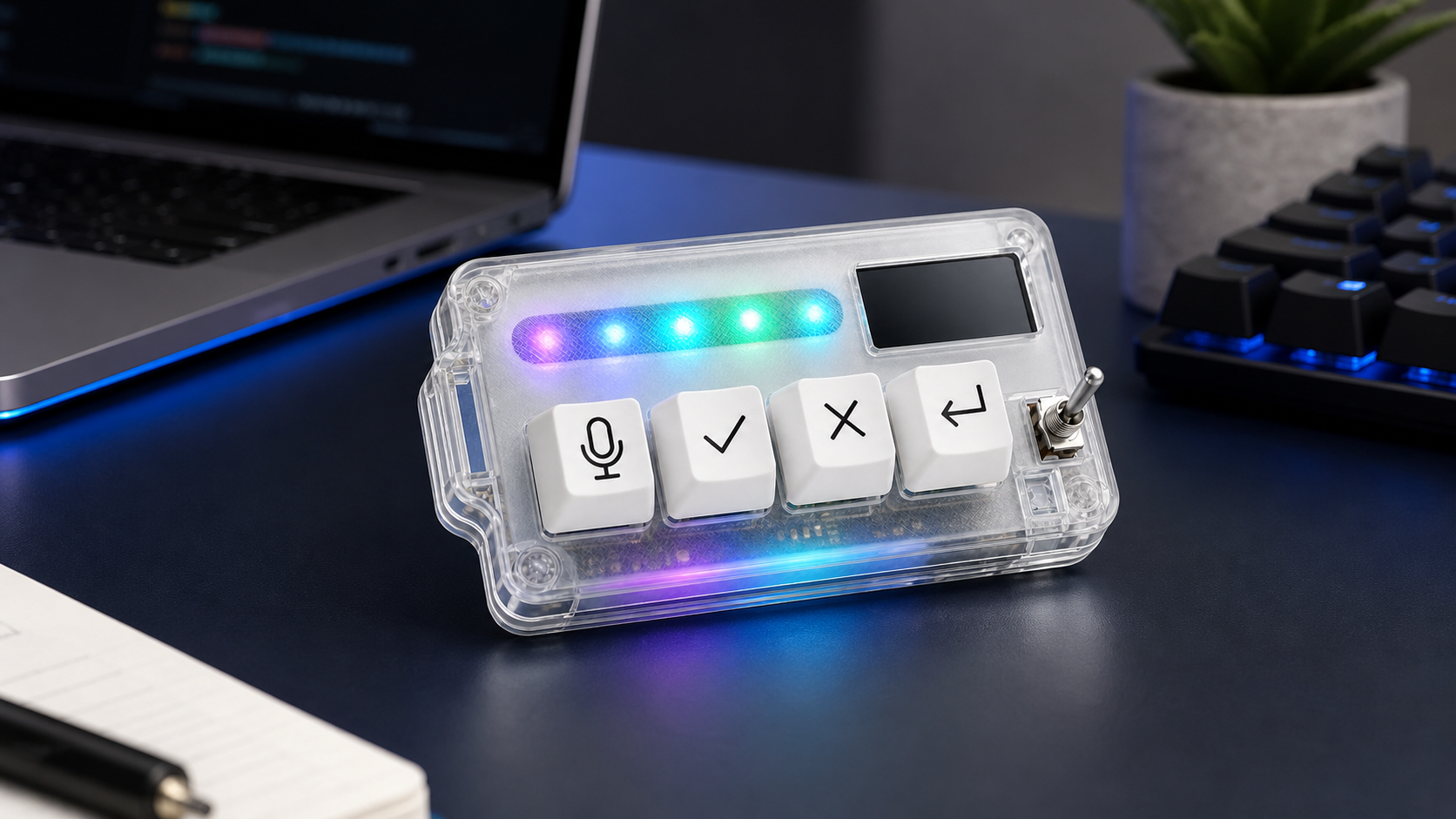
HarnessKeys is built around that small loop. It gives microphone, approve, cancel, and return-style actions their own physical keys, with USB and Bluetooth support, a custom status screen, an RGB light bar, and a compact transparent body. It is not trying to replace your main keyboard. It is trying to stop four small actions from interrupting your concentration all day.
If vibe coding currently feels more scattered than it should, do not start by adding twenty macros. Watch the four actions first. If speak, approve, cancel, and continue are the places where focus keeps leaking, the HarnessKeys AI Workflow Keypad gives those actions a calmer home.
