
Vibe Coding Fundamentals
The Hidden Input Bottleneck in AI Coding Workflows
Jun
AI coding feels fast until you notice how often the tool is waiting for you. The model can generate a refactor in seconds, but you still have to describe the task, paste the right context, approve the useful parts, reject the strange parts, and keep the session moving. That repeated human input is the hidden bottleneck in many AI coding workflows.
This bottleneck does not look like a big failure. It looks like tiny pauses. Your hand leaves the keyboard to click an approve button. You type a long explanation that would have been easier to say out loud. You scroll back to check what the agent just did. You hesitate before cancelling because the stop control is buried in the interface. The AI is moving quickly, but your command loop is not.
The slow part is often between decisions
When people measure AI coding speed, they usually compare how long it takes to generate code. That is only one part of the session. The more useful measurement is how long it takes to move from one decision to the next.
Here is a common sequence: ask for a change, wait for a response, read the diff, approve part of it, ask for a narrower follow-up, cancel a bad branch, run a test, paste the failure, and ask for the next fix. None of those steps is hard by itself. But if every step requires switching between typing, clicking, hunting, and re-reading the screen, the session starts to feel heavier than it should.
The bottleneck is not that developers type slowly. Many developers type very quickly. The bottleneck is that AI coding asks for a mix of input styles: natural language, exact code, yes/no judgment, correction, and continuation. A single full-size keyboard can do all of that, but it does not always make the repeated actions feel distinct.
Typing is precise, but it is not always the fastest way to steer
Typing is still the best tool for exact syntax, filenames, commands, and edits that need character-level accuracy. Nobody should dictate a long regular expression in a noisy room and expect joy. But for intent, voice can be faster.
Try saying this out loud: “Refactor the settings loader so the environment fallback is isolated, keep the public API the same, and add a regression test for missing keys.” That sentence is natural to speak. It is slower to type, and it becomes even slower when you stop halfway to reorganize the thought.
Voice input does not replace written code. It is useful because a lot of AI prompting is closer to explaining a task to a teammate than writing a line of code. The developer can speak the messy first version, then refine the output with text when precision matters.
Clicking becomes expensive when it repeats all day
A single click is cheap. Fifty small clicks scattered through a focused session are not. AI coding tools often put important controls in the interface: accept, reject, retry, continue, stop, open diff, send. When those controls are spread across panels, each action asks for visual attention.
That visual attention is the real cost. Your eyes leave the code to find the button. Your hand moves to the mouse. Your focus shifts from evaluating the AI output to operating the UI. You get back to the editor a moment later, but the thread in your head is thinner.
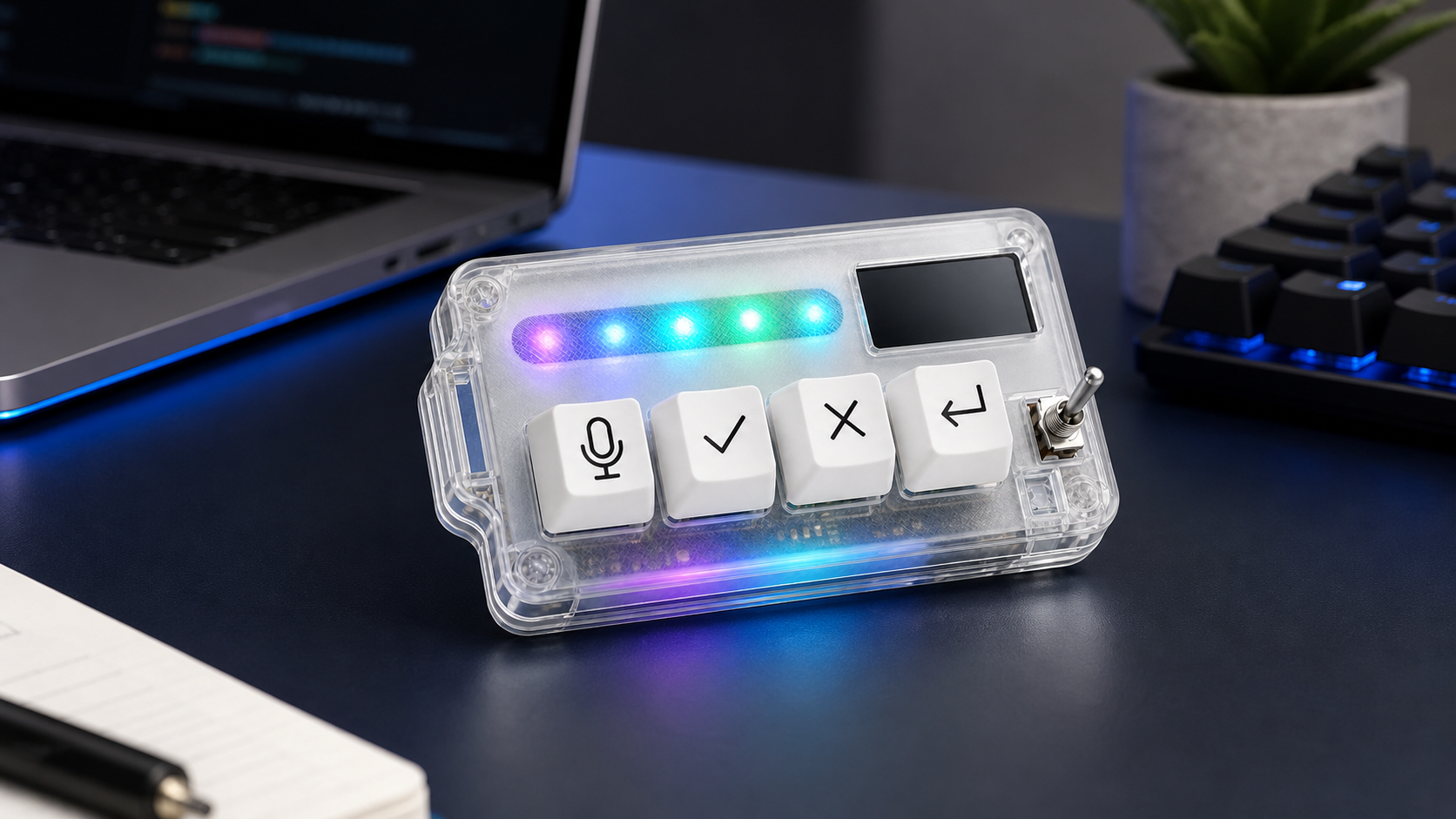
Dedicated hardware can help because it turns a visual search into a tactile habit. If one key means approve and another key means cancel, the developer can keep their eyes on the change and make the decision by touch. That does not make the decision automatic. It makes the control easier to reach.
Approval and cancellation deserve different physical feelings
Approve and cancel are not symmetrical in a good workflow. Approval moves work forward. Cancellation protects the session from wasting more time on a bad path. Both matter, and both should feel intentional.
In a software interface, those actions can sit close together. That is convenient, but it can also make the workflow feel nervous. A physical layout gives them different locations. The hand learns the difference. A check key can become the “yes, keep going” action. An X key can become the “stop, this is wrong” action. That separation is small, but it helps the brain treat the two decisions differently.
This is especially useful with AI agents that can continue working for multiple steps. Stopping early is part of quality control. If the agent misunderstood the objective, continuing is expensive. A fast cancel action is not negative; it is a safety feature.
How to tell if input is your real bottleneck
You do not need a lab test. Watch one serious AI coding session and count the repeated motions. How often do you type a long prompt that could have been spoken? How often do you reach for the mouse just to approve or stop? How often do you lose your place after moving between the editor, the chat panel, and the terminal?
If the answer is “a few times,” you probably do not need extra hardware. If the answer is “constantly,” then the input layer is worth improving. The best improvement might be better shortcuts. It might be a cleaner prompt habit. It might be a headset microphone. Or it might be a small workflow keypad that keeps the common decisions under your fingers.
Small hardware fixes work best when they stay small
The solution should not become another system to maintain. A large custom control board with dozens of macros can be powerful, but it can also become homework. The point is to reduce friction, not create a second dashboard.
HarnessKeys takes the small route: four physical keys for the core AI workflow loop, plus USB and Bluetooth support, a custom status screen, an RGB light bar, and a compact transparent body. It is designed for developers who do not want to rebuild their whole desk, but do want the repeat actions to be easier to hit.
If your AI coding sessions already feel smooth, you may not need it. But if the model is fast and your hands are still doing awkward little errands all day, the input bottleneck is real. Start by identifying the repeated actions. Then give the most important ones a better place to live. The HarnessKeys AI Workflow Keypad is one way to do that without turning your desk into a control room.
