
Vibe Coding Fundamentals
What Is a Vibe Coding Keyboard and Why Are Developers Talking About It?
Jun
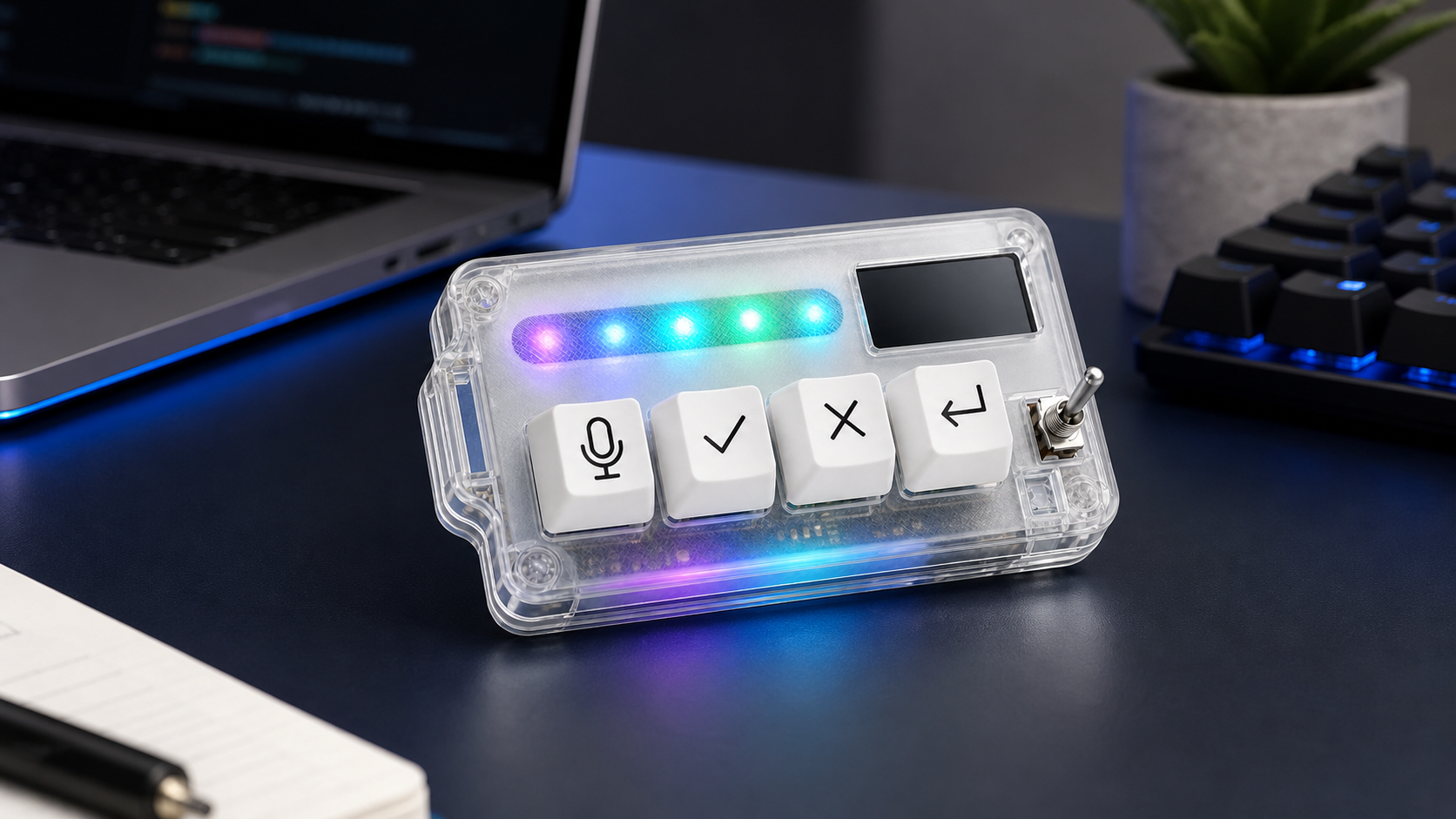
A vibe coding keyboard is a small physical control surface for the parts of AI coding that keep repeating: starting a spoken prompt, approving an answer, stopping a bad direction, and sending the next instruction. It is not meant to replace a normal keyboard. It is closer to a dedicated desk control for the moments when a developer is working with an AI coding assistant and wants less friction between thought and action.
The phrase can sound a little unserious the first time you hear it. “Vibe coding” started as a loose way to describe building software by steering AI tools with intent, examples, corrections, and quick feedback. That makes some people think a vibe coding keyboard must be a joke product or a novelty shortcut pad. The better way to understand it is simpler: AI coding changed the command loop, so some developers are experimenting with hardware that matches the new loop.
Vibe coding is a different kind of input problem
Traditional programming rewards exact typing. You write code, move through files, run tests, copy stack traces, and edit line by line. Shortcuts help, but most of the work still happens through a full keyboard and a mouse.
AI-assisted coding adds another layer. Now the developer is not only typing code. They are asking for a refactor, giving the AI a constraint, approving a suggested change, rejecting a patch, pasting an error, or telling an agent to continue. The work becomes conversational, but the interface still often feels like a form field, a chat window, and a handful of tiny buttons scattered around the screen.
That is where the “keyboard” part gets interesting. A vibe coding keyboard does not need eighty keys because the repeated AI actions are not eighty different actions. In many sessions, the same few motions keep coming back: speak, approve, cancel, submit, return to the next step. A dedicated device makes those actions easy to find without breaking attention.
Why developers are suddenly talking about physical controls again
For years, the trend was to move more work into software. More menus, more extensions, more command palettes, more automations. That still matters. But AI tools brought back an old problem: when the computer is waiting for your judgment every thirty seconds, the tiny cost of input starts to feel much bigger.
You can see this during a real coding session. The AI produces a change. You scan it. You decide it is acceptable. Then you reach for the mouse, find the right approve button, maybe miss the hit target, maybe move focus to the wrong panel, then get back to the editor. None of that is dramatic. It is just enough to interrupt the flow.
Physical controls work because they build muscle memory. A key can become “yes.” Another key can become “stop.” A microphone key can mean “I am about to explain the next thing out loud.” When the action is tactile and repeatable, the developer spends less attention finding the interface and more attention judging the output.
What makes it different from a macro pad?
A macro pad is a general-purpose device. You can map it to almost anything: app launchers, shortcuts, scripts, media controls, window management, build commands, or snippets. That flexibility is useful, but it also means the owner has to design the whole system.
A vibe coding keyboard is narrower. It starts from the AI workflow instead of from the number of buttons. The question is not “How many commands can I cram onto my desk?” The question is “Which decisions do I make again and again while working with an AI agent?”
For many developers, four actions are enough to begin: voice input for longer intent, approve for accepted output, cancel for unsafe or irrelevant direction, and return for continuing the prompt loop. That smaller surface can be easier to trust than a large grid where every key needs a label and a memory trick.
Where a four-key layout makes sense
A four-key vibe coding keyboard makes sense when your AI workflow has a rhythm. You might be using Cursor, Claude, Codex, ChatGPT, or another assistant. The exact tool matters less than the repeated pattern. You explain what you want, the AI responds, you decide whether to keep going, and you steer the next step.
Dedicated keys help most when the action is frequent and low-level. Approving a suggestion should be quick. Stopping a wrong direction should be immediate. Submitting the next instruction should not require your hand to travel across the desk. Starting voice input should feel deliberate, especially if you do not want the microphone listening all the time.
HarnessKeys is built around that idea. It is a compact AI workflow keypad with four physical keys, USB and Bluetooth support, a custom status screen, an RGB light bar, and a transparent body meant to sit beside the main keyboard. It is independent hardware, not an official accessory for any AI platform. The point is to give repeated workflow actions a stable place on the desk.
When it is probably not worth buying
This kind of device is not for everyone. If you only use AI tools once or twice a week, a normal keyboard shortcut is probably enough. If your main bottleneck is poor prompts, unclear specs, or not reviewing generated code carefully, hardware will not solve that. A keypad can make a good workflow faster; it cannot make a sloppy workflow safe.
It is also not the right answer if you want a large visual control center with dozens of labeled buttons. In that case, a Stream Deck-style device may fit better. If you want deep custom scripting, a programmable macro pad may be more flexible. A vibe coding keyboard is strongest when you want fewer controls, not more.
Common mistakes when people first try one
The first mistake is mapping too much. A new device is exciting, so it is tempting to assign every key to a clever automation. That usually makes the workflow harder to remember. Start with the actions you already perform constantly.
The second mistake is treating approve as a blind “accept everything” button. Approval should still mean that you looked at the result. The physical key should reduce interface friction, not remove judgment.
The third mistake is ignoring placement. A small keypad should sit where your hand naturally rests. If it lives too far away, it becomes another object you have to reach for. The best placement is boring: close enough to use without looking, far enough from the main keyboard that the special actions feel separate.
So, what is a vibe coding keyboard? It is a physical layer for AI-assisted development. Not a replacement for skill. Not magic. Just a way to make the repeated speak-approve-cancel-continue loop easier to control. If that loop describes your day, the HarnessKeys AI Workflow Keypad is built for exactly that kind of desk.
