
Vibe Coding Fundamentals
Why Voice Input Changes the Way Developers Prompt AI Agents
Jun
Voice input changes AI coding because prompting is often closer to explaining than typing. When a developer asks an AI agent to fix a bug, compare two approaches, or rewrite a function with constraints, the first useful version of that instruction is usually spoken-language thought. It has context, caveats, and intent. Voice lets that thought reach the tool before it gets flattened into a short, tired sentence.
That does not mean developers should code by voice all day. Exact code still belongs on the keyboard. Private information should stay private. A loud office can make dictation painful. But for steering AI tools, voice can be the fastest way to get a complete idea out of your head.
Spoken prompts are better for intent than syntax
AI agents need more than commands. They need the reason behind the command. “Fix this test” is useful, but “Fix this test without changing the public API because two downstream packages rely on it” is much better. That second sentence is easy to say. Developers often skip it when typing because it feels like extra work.
This is where voice input earns its place. It lowers the cost of giving full context. You can explain the failure, mention what you already tried, add a boundary, and ask for a specific shape of answer. The prompt becomes less like a search query and more like a short handoff to a teammate.
The trick is to choose the right material for voice. Use it for intent, constraints, summaries, review notes, and “here is what I want next.” Use the keyboard for exact identifiers, shell commands, code snippets, and anything where one wrong character matters.
The best voice prompts have a beginning and an end
Always-on voice can feel messy. A developer thinks out loud, changes direction, sighs, mutters a filename, and suddenly the AI tool has a confusing prompt. Good voice input needs a clear start and a clear stop.
A physical microphone key helps because it makes voice a deliberate mode. Press the key, speak the instruction, release or submit when finished. The gesture tells your brain: now I am talking to the tool, not just thinking near the computer.
This matters more than it sounds. Many people try dictation once, leave it open too long, get a bad transcript, and decide voice is not for developers. The problem is often not voice itself. The problem is a vague capture boundary. A dedicated trigger makes the workflow cleaner.
Where voice works beautifully in AI coding
Voice is strong when the prompt contains judgment. For example: “The last answer changed too many files. Keep the fix inside the auth callback and explain why the previous patch touched the billing module.” That sentence carries frustration, scope, and a next step. It is exactly the kind of thing developers often under-type.
Voice is also useful during code review. You can read a diff, press a microphone key, and say: “This error handling is fine, but the retry loop should stop after three attempts and log the provider response.” That is faster than turning your review into a polished paragraph before the AI sees it.
It works well for planning too. Before asking an agent to implement, you can speak the rough plan: “First inspect the current settings loader, then find where defaults are applied, then patch the narrowest function, then add one regression test.” The AI gets a sequence, and you avoid a vague one-line prompt.
Where typing still wins
Typing wins whenever exactness is the whole point. Function names, config keys, regex patterns, package names, migration filenames, and command flags are safer when entered by hand. Voice transcription can turn a small symbol into a strange mistake, and the time saved disappears when you have to correct it.
Typing also wins in shared spaces. If you work in a cafe, a library, or a busy office, speaking every prompt can be uncomfortable. It may reveal product details, customer data, or internal architecture. Voice-first does not mean voice-only. A mature workflow gives you both options and lets the situation decide.
There is also a social reality: some developers simply hate talking to a computer. That is allowed. If voice makes you self-conscious, a keypad can still be useful for approve, cancel, and continue actions. The microphone key is a tool, not a personality test.
Privacy and noise are design issues, not footnotes
Voice input should never become an excuse to leak sensitive material. Do not dictate secrets, customer data, private keys, unpublished financial details, or anything that would be unsafe in a transcript. The same rule applies to typed prompts, but voice can make people more casual, so it deserves extra attention.
Noise matters too. A laptop microphone across the desk may pick up fans, music, or other people. A closer microphone is usually better. So is a push-to-talk style trigger. The goal is not studio-quality audio. The goal is a clean enough signal that the AI tool receives the instruction you meant to send.
Desk controls make voice less awkward
The first few days of voice input can feel clumsy because the workflow has no shape. Where does the text go? How do you start listening? How do you submit? What happens if the transcript is wrong? Without clear answers, developers fall back to typing.
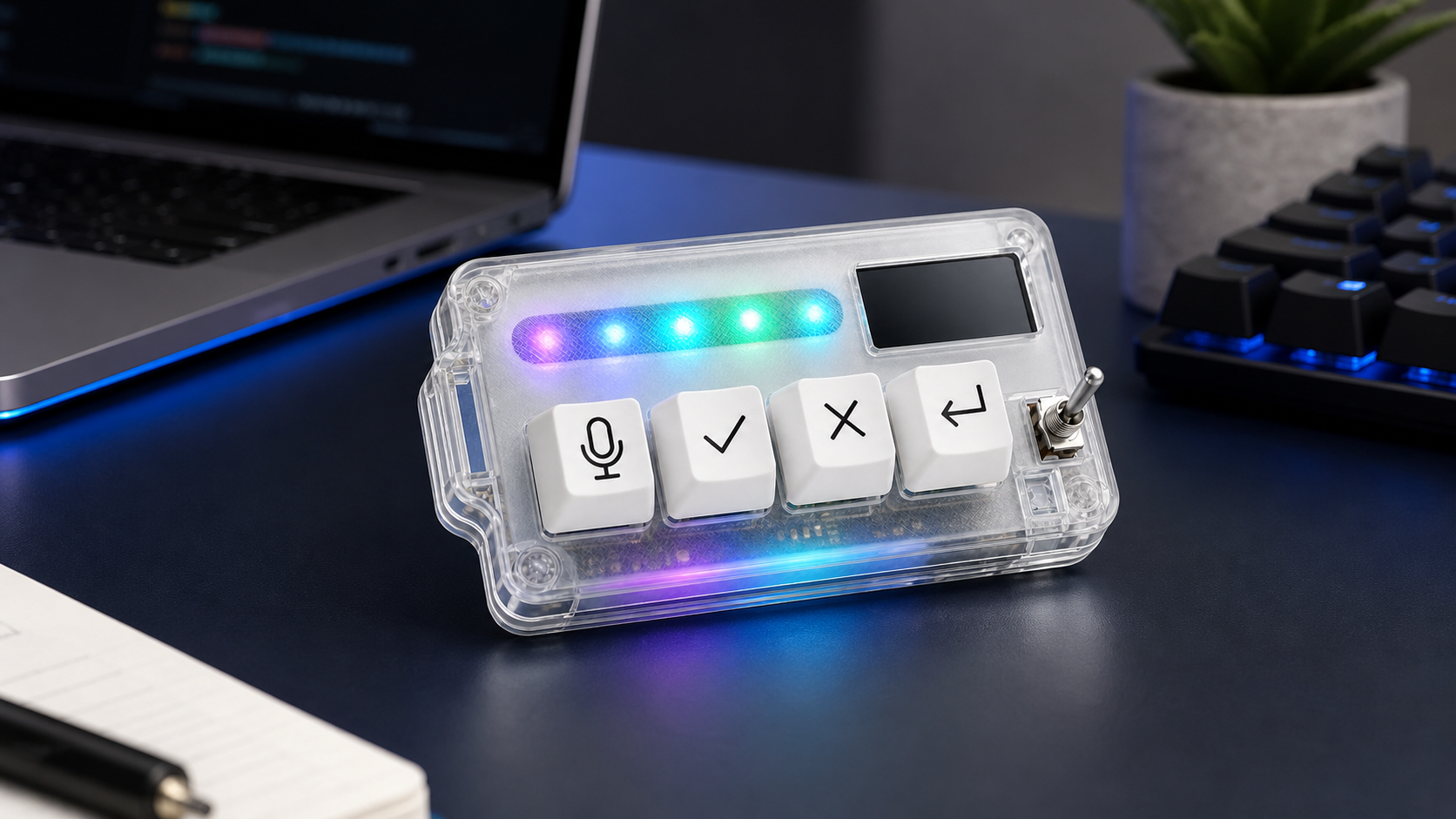
A small physical keypad can give the workflow a shape. One key starts the microphone. One key approves useful output. One key cancels a bad direction. One key submits or continues. That layout turns voice from a floating feature into part of a repeatable AI coding loop.
HarnessKeys is built around that loop. It is a compact vibe coding keyboard with microphone, approve, cancel, and return-style keys, plus USB and Bluetooth support, a custom status screen, and an RGB light bar. It is independent hardware and should be treated as a workflow layer rather than an official accessory for any AI coding platform.
The real promise of voice input is not that developers will stop typing. They will not. The promise is that intent can move faster. When the idea is fuzzy, speak it. When the code must be exact, type it. When the AI response needs judgment, use a deliberate approve or cancel action. That mix is where voice input starts to feel practical instead of theatrical. For a desk setup built around that mix, see the HarnessKeys AI Workflow Keypad.
