
Vibe Coding Fundamentals
Why Approve Cancel and Return Deserve Dedicated Keys in AI Coding
Jun
Approve, cancel, and return sound too ordinary to deserve dedicated keys. That is exactly why they matter. In AI coding, the ordinary decisions repeat constantly. You accept a suggestion. You stop a bad path. You send the next instruction. You do it again ten minutes later, then again after a test failure, then again while reviewing a diff. Small actions become the rhythm of the whole session.
When those actions stay buried in software controls, the developer keeps paying a tiny attention tax. Find the button. Check the focus. Move the hand. Click. Return to the code. A dedicated key does not make the AI smarter, but it can make the human control loop cleaner.
The repeated decision loop is the real interface
Most AI coding tools are described by their big features: code generation, refactoring, test writing, debugging, agent mode, chat context. Those features matter, but the day-to-day interface is often smaller. It is a loop of decision points.
Should the proposed change be accepted? Should the agent continue? Did it misunderstand the task? Is this patch safe enough to inspect further? Should the next prompt be a correction, a narrower instruction, or a fresh start?
Approve, cancel, and return sit right inside that loop. They are not glamorous actions. They are control actions. If they are slow or awkward, the whole workflow feels less fluid.
Approval should feel intentional, not automatic
A dedicated approve key is useful only if it still represents judgment. It should not become a reflexive “yes to everything” button. AI-generated code can be useful, strange, incomplete, or quietly wrong. The developer still has to read the result.
The value of a physical approve key is that it separates the decision from the interface hunt. Your eyes can stay on the diff. Your hand knows where the yes action lives. The approval feels like a deliberate step, not a random click inside a busy panel.
This is especially helpful when reviewing small changes. If the agent updates a test name, fixes a typo, or applies a narrow refactor you expected, the accept action should be quick. The time should go into reading, not operating the UI.
Cancel is a safety control, not a negative button
Good AI workflows need fast cancellation. That sounds pessimistic until you watch an agent go down the wrong path. It can create files you did not ask for, broaden the scope, misunderstand a requirement, or keep explaining when you already know the issue.
Stopping early is a skill. A dedicated cancel key reinforces that skill because it makes the stop action easy to reach. You do not have to search the screen while the tool continues in the wrong direction. You can interrupt, correct, and preserve the session.
Cancel also gives developers a healthier relationship with AI output. The goal is not to let the model continue because it started. The goal is to steer. A clean stop signal is part of steering.
Return keeps the conversation moving
Return, submit, continue, next turn: the exact label depends on the tool. The job is the same. It moves the workflow from prepared instruction to active request.
On a normal keyboard, Enter already exists. So why dedicate another key? Because in AI coding, the return-style action often belongs to a separate context. It may submit a spoken prompt. It may continue an agent step. It may confirm that the next instruction is ready. Separating that action from ordinary typing can reduce accidental submits and make the workflow feel cleaner.
This matters most when voice input is involved. A developer may press a microphone key, speak a prompt, glance at the transcript, then hit return to send it. The sequence becomes physical: speak, check, send. That is easier to repeat than a loose mix of keyboard focus, mouse clicks, and interface buttons.
Physical separation helps muscle memory
Muscle memory is not only about speed. It is also about confidence. When approve, cancel, and return live in distinct physical positions, the hand learns their meaning. The developer can act without constantly looking away from the work.
This is why key choice and placement matter. Approve should not feel easy to confuse with cancel. Return should be comfortable but still deliberate. The microphone key should be reachable without turning on voice by accident. A good layout makes the common path fast and the risky path clear.
That physical separation is difficult to reproduce with a crowded interface. On screen, buttons can move, panels can collapse, and focus can shift. On a small keypad, the control stays where the hand expects it.
What not to map to these keys
Do not start by mapping destructive commands. A physical key should not delete files, force-push code, drop a database, or deploy production changes without a confirmation step. It is tempting to make the device powerful on day one. Resist that temptation.
Start with decisions that are common and reversible. Approve a suggestion after review. Cancel a bad generation. Submit the next prompt. Trigger voice input. These actions reduce friction without turning the keypad into a risk source.
If you later add advanced mappings, keep them clearly separated and test them in a safe environment. The best AI coding setup is not the one with the most dramatic shortcuts. It is the one you can trust during a tired afternoon.
Why HarnessKeys uses this kind of layout
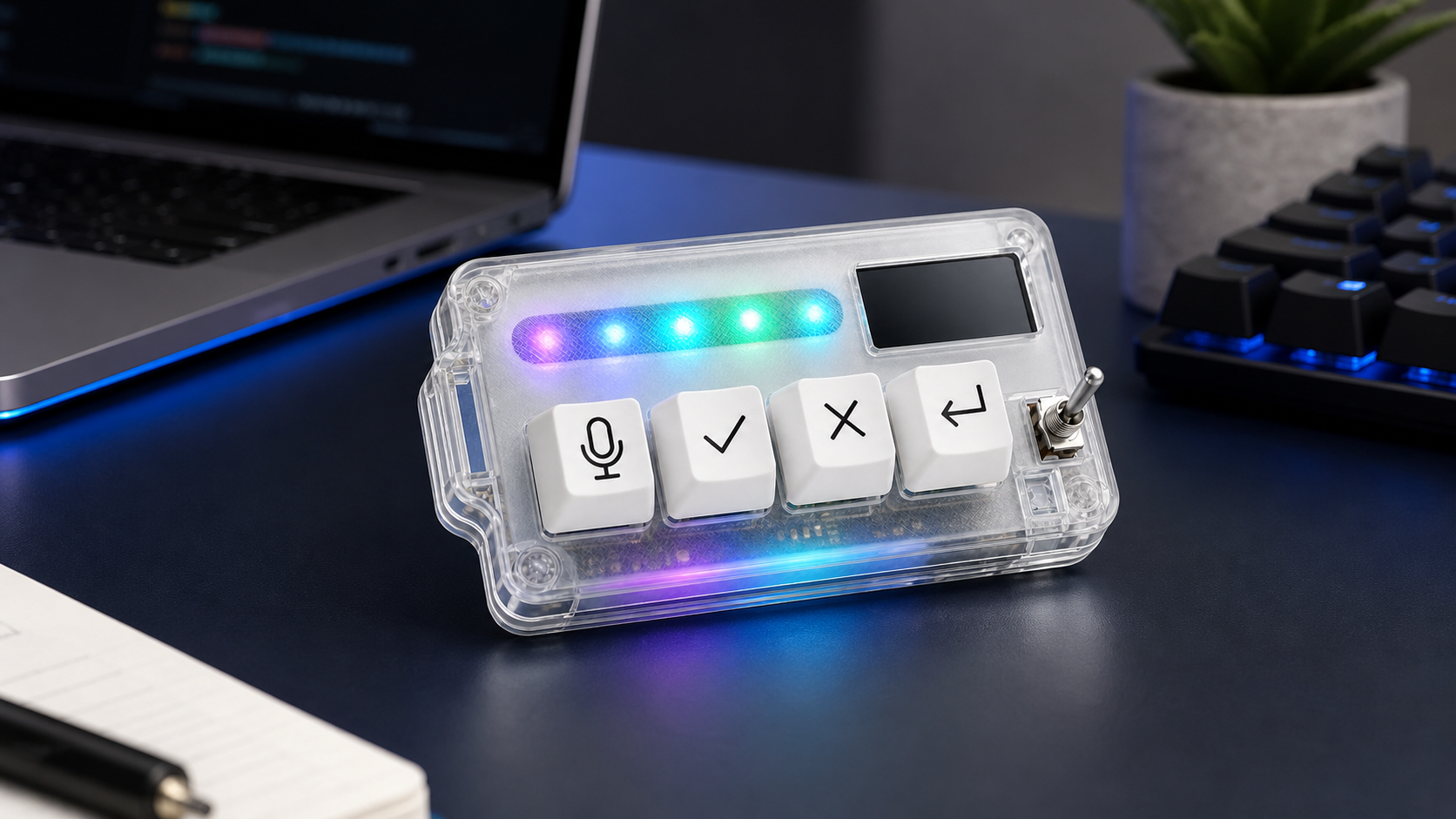
HarnessKeys focuses on the core control loop instead of trying to become a general command board. The four physical keys are built around microphone, approve, cancel, and return-style actions. The device also includes USB and Bluetooth support, a custom status screen, an RGB light bar, and a compact transparent case.
That narrowness is the point. If your AI workflow mostly needs fifty app shortcuts, choose a larger programmable device. If your workflow keeps coming back to the same few decisions, a four-key vibe coding keyboard may feel faster because it is easier to remember.
Approve, cancel, and return deserve dedicated keys because they are where the developer stays in control. AI coding is not just generation. It is judgment, interruption, correction, and continuation. Put those actions somewhere your hand can trust, and the whole session feels less scattered. The HarnessKeys AI Workflow Keypad is built for that repeated control loop.
