
Comparison and Buying Guides
Dedicated AI Workflow Keypad vs Keyboard Shortcuts
Jun
Keyboard shortcuts are still powerful. A dedicated AI workflow keypad does not change that. The real question is whether shortcuts alone are comfortable for the new actions AI coding adds: speaking prompts, approving agent steps, cancelling wrong directions, and continuing prompt turns.
For some developers, shortcuts are enough. For others, the AI control loop becomes easier when those actions have physical separation from normal typing.
Shortcuts are best for known software commands
Shortcuts shine when the action is fixed and familiar. Save, search, open file, run command, format, navigate, split pane. Developers build years of muscle memory around these operations, and the main keyboard is the right place for them.
If your AI tool exposes reliable shortcuts for everything you need, and you remember them without hesitation, you may not need extra hardware. A clean shortcut system is hard to beat.
The weakness appears when AI controls begin crowding the same mental space as editor shortcuts.
Shortcut overload is easy to miss
Shortcut overload does not feel dramatic. It feels like hesitation. Which chord approves this AI suggestion? Which one cancels? Does Enter submit the prompt or create a new line? Did focus move to the chat panel or stay in the editor?
When a workflow creates too many context-dependent shortcuts, the user starts falling back to the mouse. That fallback is a clue. The shortcut exists, but it has not become trusted muscle memory.
AI coding makes this worse because the actions are decision-heavy. Approval and cancellation are not just commands. They represent judgment.
Physical separation can improve confidence
A dedicated keypad separates AI workflow control from ordinary typing. The main keyboard remains for code, editor navigation, and text. The keypad handles microphone, approve, cancel, and return-style actions.
That separation can make the workflow feel calmer. A physical cancel key is easier to trust than a shortcut you only half remember. A microphone key can mark the beginning of voice input. An approve key can become a deliberate yes after review.
The benefit is not raw speed alone. It is confidence in repeated decisions.
Safety improves when meanings stay stable
Keyboard shortcuts can change meaning depending on focus. Enter in a prompt field may submit. Enter in an editor creates a new line. Escape may cancel, close a modal, or blur focus. These are normal software patterns, but they can complicate AI workflows.
A physical workflow key can have a narrower meaning. It should not do everything. It should do one repeated AI action predictably. That narrower meaning reduces mistakes.
This is especially important for approve and cancel. Those two decisions should feel distinct by touch.
A hybrid approach is often best
The strongest setup is usually hybrid. Keep normal development shortcuts on the main keyboard. Put repeated AI workflow controls on the keypad. Use the mouse when visual selection truly matters. Use voice when the prompt is easier to explain than type.
This avoids an all-or-nothing decision. You do not need to abandon shortcuts to use a keypad. You only move the actions that benefit from physical separation.
After a week, the pattern becomes obvious. If you still use a main-keyboard shortcut without hesitation, keep it there. If you keep hunting or misfiring, consider moving that action to hardware.
Use the mouse fallback as evidence
Many developers claim shortcuts are enough, then keep reaching for the mouse during AI sessions. That is not a character flaw. It is evidence. The shortcut may exist, but it has not become reliable enough in the moment when the decision appears.
Watch for specific fallback moments: approving a patch, stopping generation, submitting a dictated prompt, or continuing an agent step. If the mouse keeps winning, physical separation may be worth testing.
If the mouse does not interrupt you and the shortcuts feel natural, do not buy hardware just to solve a problem you do not have.
Consider the cost of focus switching
A shortcut can be technically efficient and still feel wrong if it forces you to think about focus. AI tools often live in side panels, browser tabs, terminals, and editor surfaces. The same key may behave differently depending on where the cursor is.
A dedicated keypad can reduce that uncertainty when mapped conservatively. The device does not need to know every app state. It needs to give a few repeated actions a stable physical trigger that the user can test and trust.
Where HarnessKeys makes sense
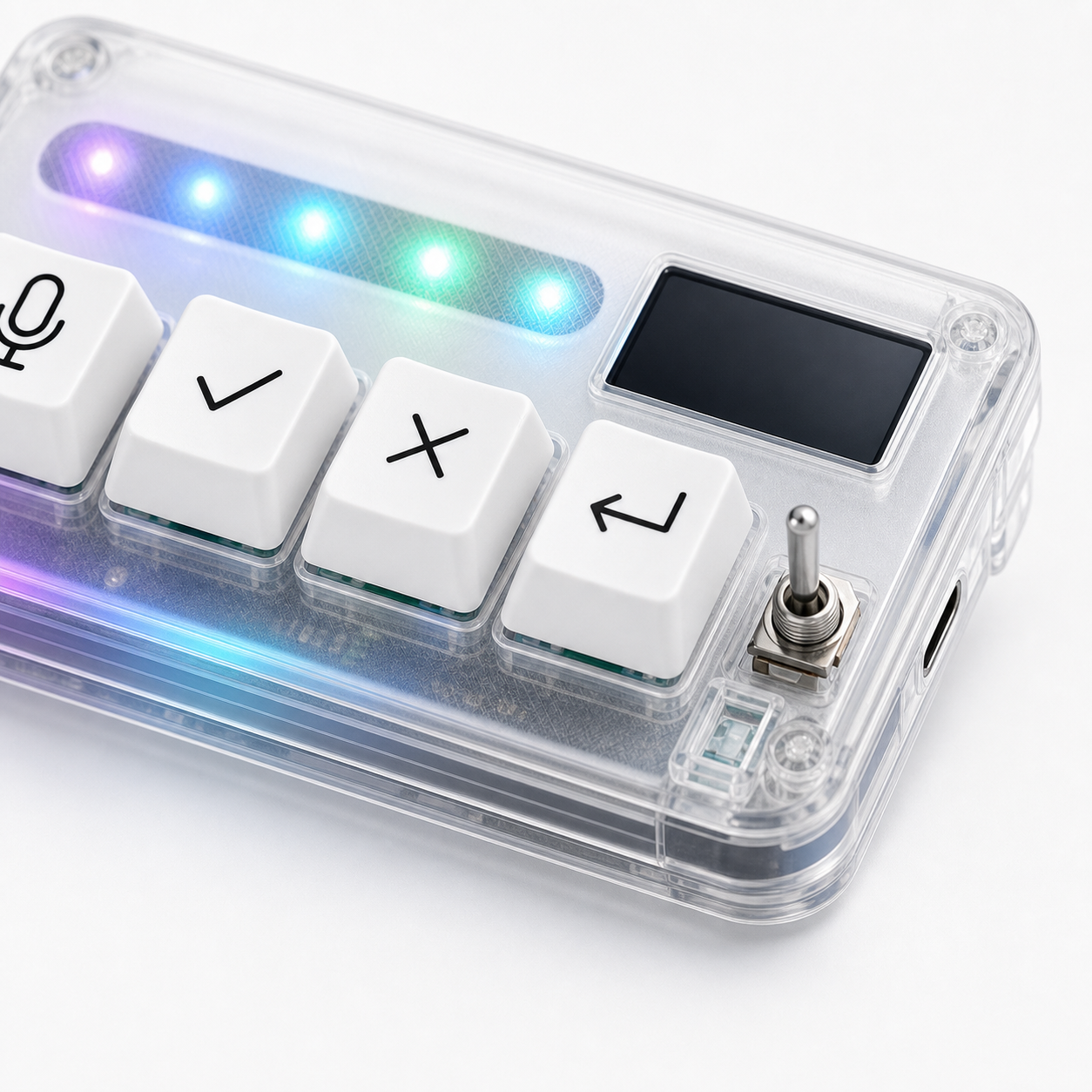
HarnessKeys makes sense when the repeated AI controls are distinct enough to deserve their own place. Its four physical keys cover microphone, approve, cancel, and return-style actions. It also includes USB and Bluetooth support, a custom status screen, and an RGB light bar.
It is not a replacement for your main keyboard shortcuts. It is a companion for the AI workflow layer.
If shortcuts alone already feel effortless, wait. If AI actions are causing hesitation, mouse travel, or accidental submits, a dedicated keypad may be worth testing. Compare the hardware details on the HarnessKeys product page, then check payment methods and shipping delivery before checkout.
