
Vibe Coding Fundamentals
The New Developer Desk Stack: AI Tool Voice Input and Physical Controls
Jun
The modern developer desk is no longer just a laptop, an editor, and a mechanical keyboard. AI tools added a new layer of work: prompts, approvals, agent steps, spoken context, review loops, and quick corrections. A good desk stack now has to support that layer without becoming messy.
The goal is not to build a dramatic command center. Most developers do not need more clutter. The better goal is a desk where each input method has a clear job. The keyboard handles exact text. Voice handles intent. Physical controls handle repeated AI actions. The screen shows enough feedback to keep the user oriented.
Start with the core software, not the hardware
The first part of the stack is still software. Which AI coding tool do you actually use every day? Cursor, Claude, Codex, ChatGPT, editor-integrated assistants, terminal agents, and browser tools all create different habits. Hardware should follow the workflow, not the other way around.
Spend one or two sessions watching what you repeat. Do you approve suggestions often? Do you cancel agent runs? Do you type long prompts? Do you keep moving between editor, chat, and terminal? Those observations are more useful than reading a list of gadget features.
A clean desk stack begins with one chosen workflow. Pick the tool, pick the project type, and map the actual loop. After that, the hardware decisions become much less abstract.
The voice layer is for intent
Voice input belongs in the stack when the developer often needs to explain context. Spoken prompts are good for sentences like: “This fix should stay inside the checkout module, preserve the API, and add one regression test for failed payment retries.” That is easier to say than to type when the idea is still fresh.
Voice is not the right layer for everything. It is weak for exact symbols, package names, shell commands, and sensitive information in a shared room. Treat it as an intent layer, not a total replacement for typing.
The practical question is how voice starts. A push-to-talk style trigger is usually better than vague always-on capture. It makes speaking feel deliberate, and it prevents half-formed thoughts from becoming prompts.
Physical controls are for repeated decisions
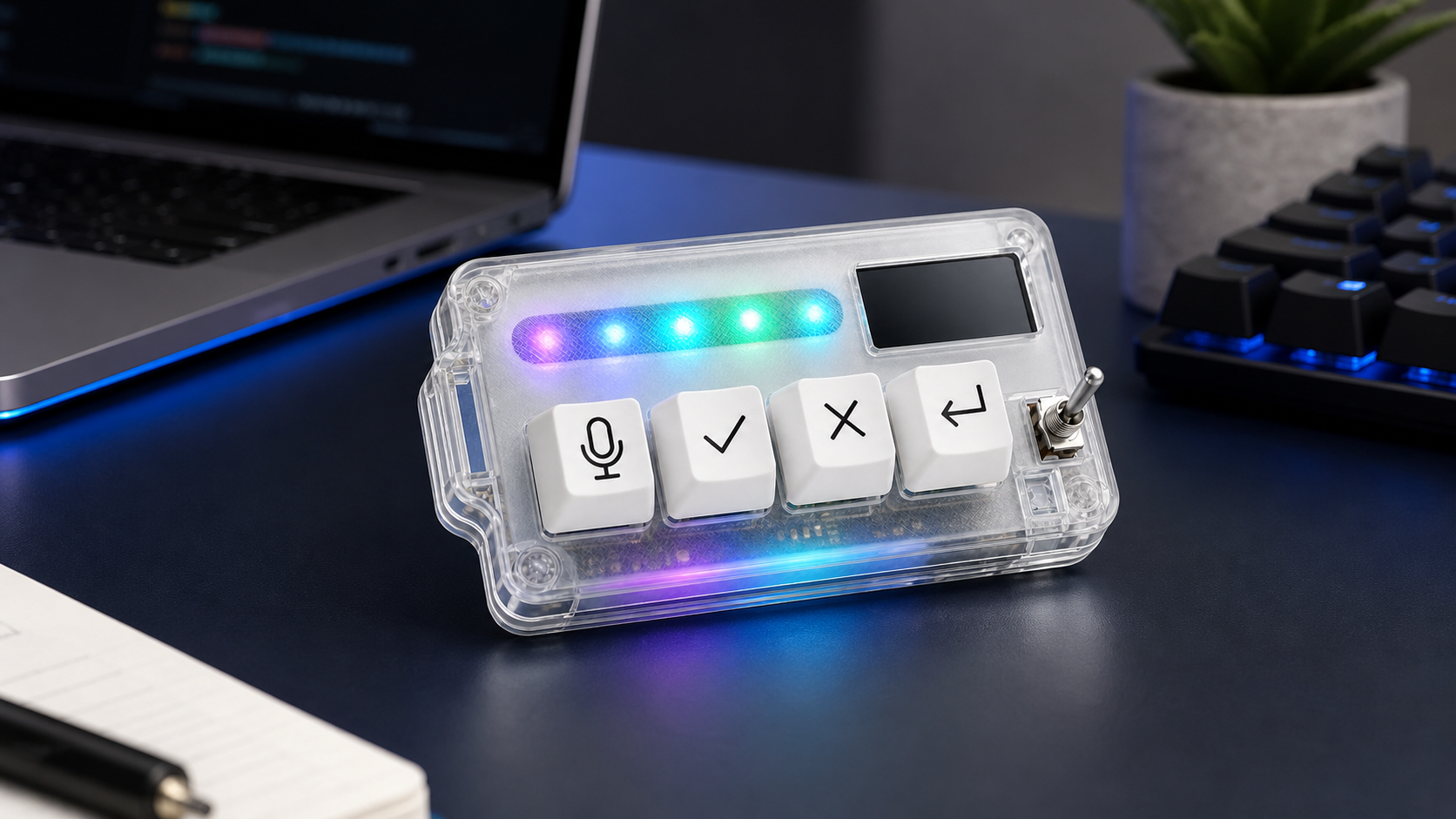
A developer desk stack starts to feel better when repeated decisions have stable controls. Approve should not require hunting through the interface. Cancel should be easy to hit when the agent goes the wrong way. Return or continue should not be confused with ordinary typing. Microphone input should have a clear trigger.
These controls do not need to be numerous. In fact, fewer may be better. If the device has too many buttons, the developer has to remember a new system. A small set of physical actions can become muscle memory much faster.
This is where a compact workflow keypad fits. It does not replace the full keyboard. It gives the AI layer a smaller, clearer set of controls that live beside the normal development tools.
Display feedback should reduce uncertainty
Small screens and lights can be useful, but only when they tell the user something they would otherwise check manually. Connection state, active mode, listening status, or a simple workflow reminder can reduce uncertainty. Decorative motion is less valuable.
The best feedback is glanceable. You should not need to study a tiny screen during a coding session. If the display helps you confirm the device is active, connected, or in the right mode, it is doing real work.
There is a limit, though. A status screen should not become another dashboard competing for attention. The main screen still carries the code, the diff, and the AI output. Desk hardware should support that focus, not pull the eyes away constantly.
Cables and Bluetooth are workflow choices
Connection mode is not just a specification. USB and Bluetooth affect how the desk feels. USB is usually best for setup, reliability testing, and fixed workstations. A cable also removes battery worries and pairing confusion.
Bluetooth is useful when the desk changes often. Laptop users, standing desk users, and people who move between rooms may prefer a wireless layout. A small keypad can sit wherever the hand naturally reaches instead of wherever a cable allows.
The best stack may use both. Start wired when configuring or troubleshooting. Switch to Bluetooth when the mappings are stable and placement matters more than the cable.
What a clean AI desk stack looks like
A clean stack is not complicated. It might be a laptop or monitor, a main keyboard, a mouse or trackpad, one AI coding tool, a voice input path, and a small physical control surface. The key is that each part has a role.
The main keyboard is still for code. The AI tool is for generation and reasoning support. Voice is for rich instructions. The physical keypad is for repeated control actions. The display feedback is for quick orientation. When each layer is clear, the desk feels calmer.
HarnessKeys is built for this kind of stack. It offers four physical keys for microphone, approve, cancel, and return-style actions, with USB and Bluetooth support, a custom status screen, an RGB light bar, and a compact transparent body. It is independent hardware for the AI workflow layer, not an official accessory for any single AI platform.
The best developer desk stack is the one that removes repeated friction without becoming a new hobby. Start with your actual AI loop. Add voice only where it helps. Add physical controls only where decisions repeat. If those repeated controls are the missing layer, the HarnessKeys AI Workflow Keypad is designed to fit into the stack without taking over the desk.
