
Vibe Coding Fundamentals
How AI Agents Changed the Meaning of a Keyboard Shortcut
Jun
A keyboard shortcut used to mean a faster way to run a known command. Save the file. Open search. Toggle a panel. Run the formatter. AI agents changed that meaning because many shortcuts are no longer just commands. They are decisions inside a conversation: approve this step, stop that direction, send the next instruction, or ask the agent to keep going.
That sounds like a small change, but it affects how developers should think about shortcut design. A normal shortcut is mostly about speed. An AI-agent shortcut is about speed plus intent. Pressing it may move the agent forward, accept a change, cancel work, or hand off more context. The shortcut becomes part of the control system, not just a convenience.
Old shortcuts were built for predictable commands
Traditional shortcuts are great because the outcome is usually known in advance. Command-S saves. Command-F searches. A terminal alias runs a familiar command. An editor chord opens a file or moves to a symbol. The user knows what will happen before pressing the keys.
That predictability is why shortcuts can become so fast. The action is fixed, the result is familiar, and the risk is low. You are not making a fresh judgment every time you format a file. You are asking the computer to perform an operation you already trust.
AI coding does not always work that way. The agent may propose code you have not read yet. It may ask permission to edit files. It may continue from a partial understanding of the task. The shortcut is no longer only “do the thing.” It can mean “I have reviewed this enough to move forward.”
AI-agent shortcuts live inside a loop
A typical AI coding session has a loop: explain the task, wait for output, review the result, approve or reject it, then give the next instruction. The same loop may repeat dozens of times during a refactor, debugging session, or test-writing pass.
Shortcuts inside that loop feel different from ordinary app shortcuts. A key that submits a prompt is not the same as a key that inserts a newline. A key that approves an agent step is not the same as a key that clicks a static menu item. A key that cancels generation is a safety tool, not a productivity trick.
Once you see the loop clearly, shortcut mapping becomes easier. The goal is not to map every possible AI feature. The goal is to map the recurring decisions that interrupt flow.
Risky commands need stronger boundaries
AI-agent shortcuts can become risky when they trigger actions with consequences. A physical key that sends a prompt is usually safe. A key that accepts a patch after review can be safe. A key that force-runs a destructive command is a bad idea unless there is a confirmation step you truly trust.
The danger is not only technical. It is behavioral. If a shortcut makes approval too easy, the developer may stop reading carefully. If a cancel action is hidden, the developer may let the agent continue too long. If submit and newline are too easy to confuse, a half-written prompt can be sent before it is ready.
Good AI-agent shortcut design respects the difference between low-risk rhythm and high-risk execution. Put frequent control actions close to the hand. Put destructive actions behind friction.
Confirmation patterns matter more than cleverness
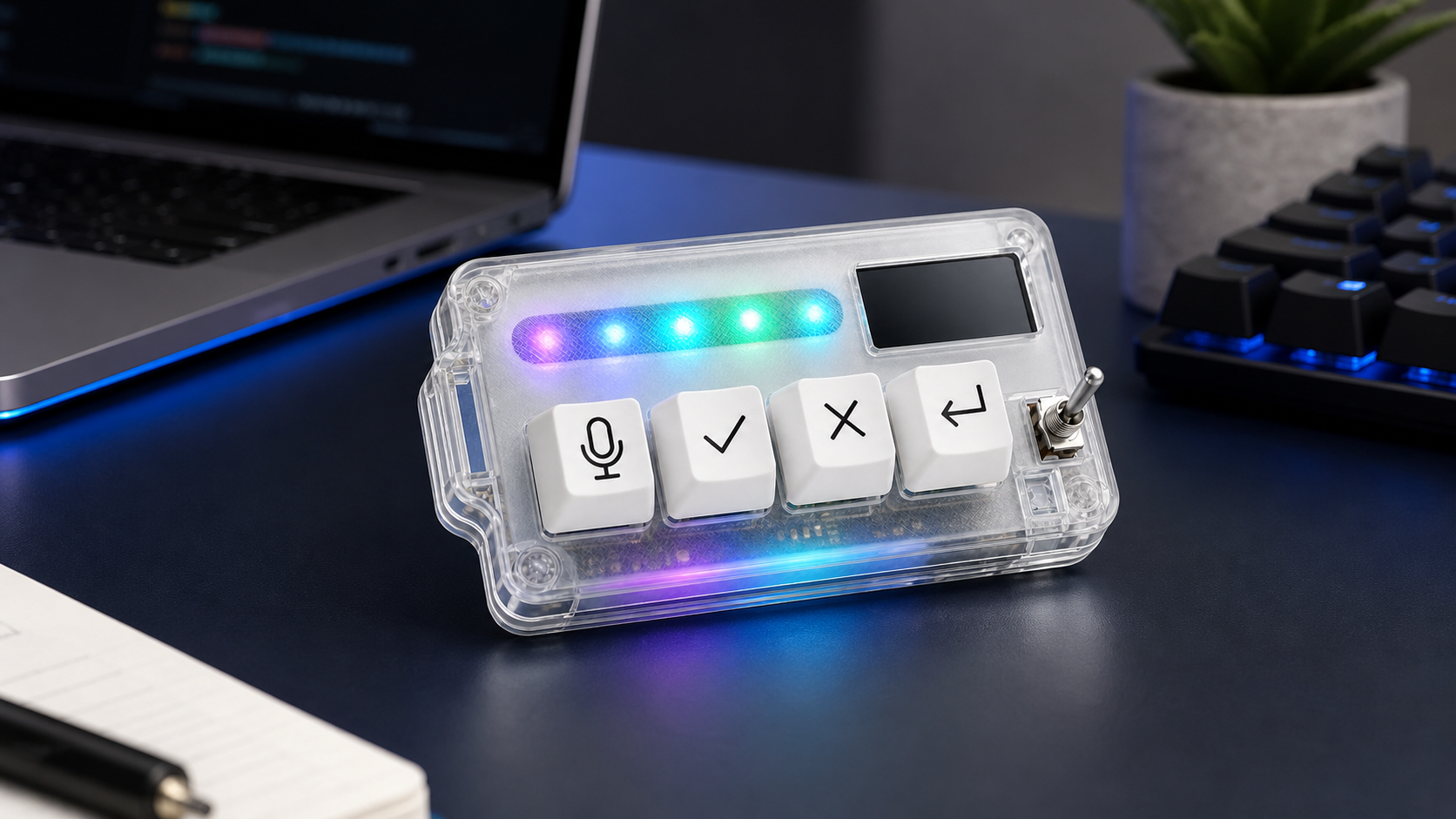
The best AI workflow shortcuts are often boring. A microphone key starts a spoken prompt. An approve key confirms a reviewed result. A cancel key stops the current direction. A return-style key sends or continues the next turn. These mappings are easy to understand because they match the way the session already feels.
Clever shortcuts can be tempting. One key to rewrite the whole file. One key to run a deployment. One key to accept all changes. Those may be useful in specific controlled environments, but they should not be the first layer of an AI coding setup.
Start with confirmation patterns. What does yes mean? What does stop mean? What does next mean? What does “I am about to speak to the AI” mean? Once those basics feel solid, more advanced mappings can be added without turning the desk into a hazard.
Safe mappings for an AI coding desk
A safe first mapping set should be frequent, understandable, and reversible. Voice input is a good candidate because it captures intent rather than executing code. Approve can be safe when it follows review. Cancel is safe because it reduces runaway work. Return or continue is safe when it submits the next prompt after the user has chosen to send it.
Be more careful with mappings that change files, run scripts, or affect production systems. Those actions may belong in the normal editor, terminal, or deployment flow where existing confirmations and logs are already present. Physical keys feel powerful, and that power should be reserved for controls that benefit from speed.
HarnessKeys is designed for this safer layer of AI-agent control. It gives microphone, approve, cancel, and return-style actions physical keys, while keeping the device compact enough to sit beside the main keyboard. It also supports USB and Bluetooth, includes a custom status screen, and uses an RGB light bar for quick feedback.
The meaning of a keyboard shortcut changed because AI coding changed the shape of the work. Developers are not only launching commands. They are steering agents. Shortcuts should reflect that. If the shortcut represents judgment, design it with care. If the action repeats all day, give it a reliable place. The HarnessKeys AI Workflow Keypad focuses on that control layer instead of trying to replace the keyboard you already use.
