
Vibe Coding Fundamentals
Vibe Coding Hardware Terms Explained: Keypad Macro Pad Stream Deck and Remote
Jun
The hardware words around vibe coding can get messy fast. Keypad, macro pad, Stream Deck, remote, controller, AI keyboard, workflow keyboard: people use these terms as if they mean the same thing, but they point to different expectations. If you are shopping for a device to control AI coding workflows, the words matter because they shape what you think the device should do.
This guide keeps the definitions practical. Not dictionary-perfect, not forum-argument perfect. Just useful enough to help a developer decide what kind of hardware belongs on the desk.
Keypad usually means a small set of physical keys
A keypad is the broadest term. It usually means a small device with a limited number of physical keys. It may be simple or programmable. It may be used for numbers, shortcuts, media controls, gaming, accessibility, or workflow actions.
For AI coding, the useful part of a keypad is its physical directness. A key can become a repeated action: start microphone input, approve an output, cancel a bad direction, or send the next prompt. The key is easy to find by touch, and the action can become muscle memory.
When someone says “vibe coding keyboard,” they often mean this kind of small keypad rather than a full typing keyboard.
Macro pad means programmability first
A macro pad is usually a programmable keypad. Its main promise is flexibility. You can map keys to shortcuts, text snippets, scripts, app commands, window controls, or multi-step actions. For power users, that flexibility is valuable.
The trade-off is setup effort. A macro pad does not automatically know your AI coding workflow. You have to decide what each key means, test the mappings, label the layout, and remember the system later. Some developers enjoy that. Others just want the common AI controls to work in a predictable way.
If you want deep customization across many apps, “macro pad” is the term to search. If you want a focused AI workflow device, a smaller vibe coding keypad may be a better fit.
Stream Deck usually means visual buttons and menus
Stream Deck is a familiar product category for many creators and developers. People often use the name casually to describe devices with multiple programmable buttons, often with small displays under each key. They are excellent for visual labels, profiles, scenes, shortcuts, and menu-like workflows.
That visual layer is powerful. It is also a different style of interaction. A visual deck asks you to look at the device, choose the labeled button, and sometimes move through pages of commands. That can be perfect for streaming, production, and complex app control.
AI coding does not always need that much surface area. If the core actions are speak, approve, cancel, and continue, a tactile keypad may be faster because the hand can operate it without looking down.
Remote control means distance and simplicity
A remote is usually about controlling something from a distance. Presentation remotes, media remotes, and camera remotes are built around simple actions: next, back, play, pause, start, stop. The appeal is that the controls are obvious.
Some AI workflow devices feel remote-like because they focus on a tiny number of commands. That can be a strength. A device does not need to be complicated to be useful. In fact, AI coding often benefits from controls that are almost boring: yes, no, speak, next.
The limitation is that a remote may not fit a desk workflow as well as a keypad. Shape, placement, connection mode, and key feel all matter when the device is used beside a main keyboard for hours.
AI keyboard can mean too many things
“AI keyboard” is the most confusing term. It might mean a software keyboard with AI writing features. It might mean a full hardware keyboard with AI shortcuts. It might mean a small keypad for AI tools. It might even mean a marketing label with no clear workflow behind it.
When you see the term, ask what the device actually controls. Does it help write text? Does it trigger prompts? Does it approve or cancel agent actions? Does it provide voice input? Does it connect by USB or Bluetooth? Does it require a specific platform?
The concrete behavior matters more than the label.
Which term fits HarnessKeys?
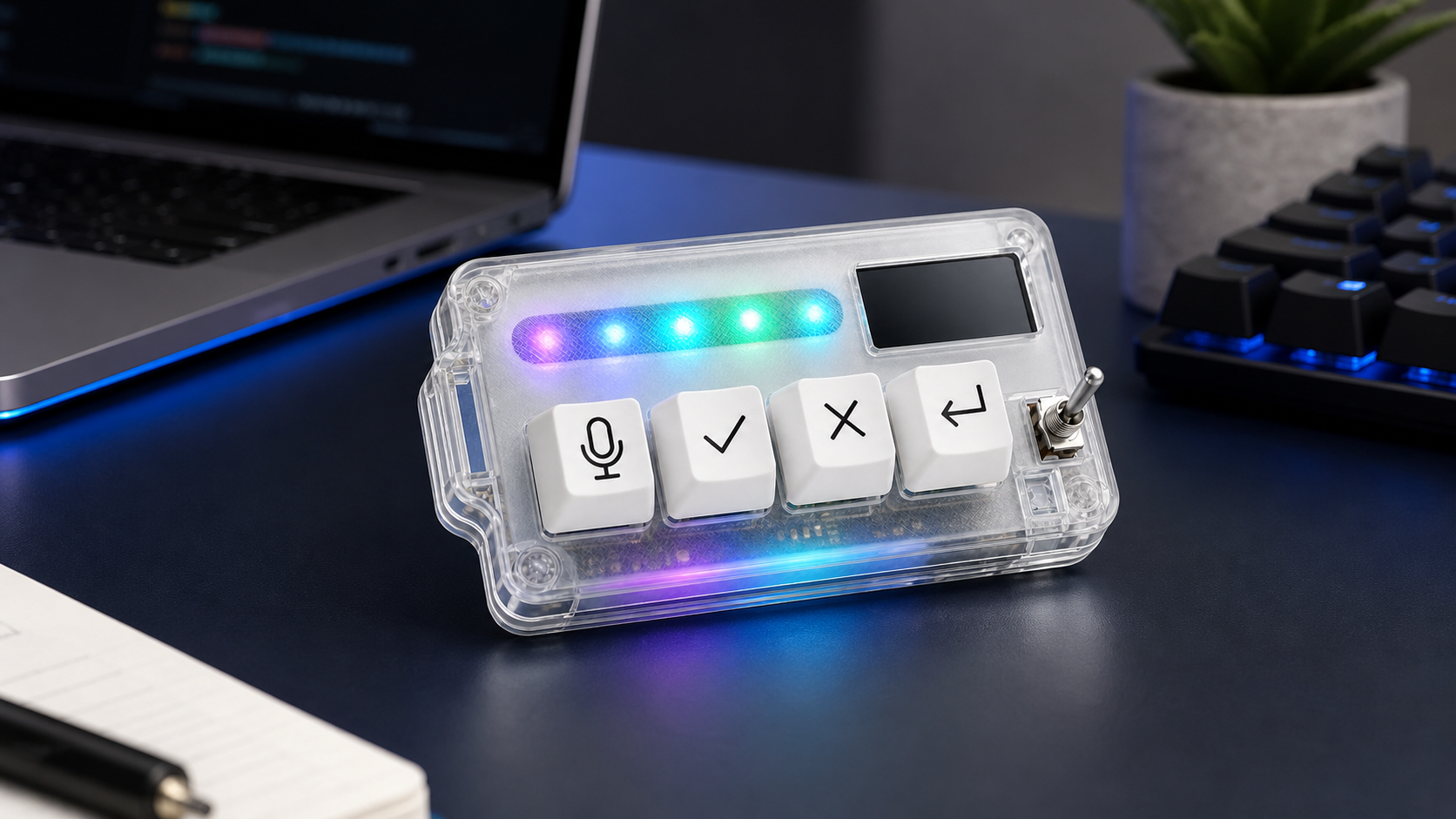
HarnessKeys is best described as a vibe coding keyboard or AI workflow keypad. It is not a full typing keyboard. It is not trying to be a large visual command deck. It is not just a generic remote. It is a compact hardware layer for repeated AI coding actions.
The device uses four physical keys for microphone, approve, cancel, and return-style actions. It supports USB and Bluetooth, includes a custom status screen, has an RGB light bar, and uses a transparent body designed to sit near the main keyboard. It is independent hardware, not an official accessory for Cursor, Claude, Codex, ChatGPT, or any other AI platform.
That positioning matters because it sets the right expectation. HarnessKeys is for developers who want a small, tactile control surface for the repeated AI workflow loop. It is not for people who need fifty visual buttons or a general-purpose scripting board.
How to choose the word when you search
If you want flexibility, search for macro pads. If you want visual controls, search for Stream Deck alternatives. If you want a tiny controller for a few actions, search for keypad or remote. If your real use case is AI coding, include phrases like vibe coding keyboard, AI workflow keypad, voice input AI coding, approve cancel AI agent, or AI coding control surface.
Good search terms save time because they bring you closer to the actual workflow. The right device is not the one with the trendiest label. It is the one whose controls match the actions you repeat every day. For a focused four-key option built around AI coding, review the HarnessKeys AI Workflow Keypad.
