
Vibe Coding Fundamentals
Why a Tiny Keypad Can Beat a Full Keyboard for AI Agent Control
Jun
A tiny keypad can look unnecessary beside a full keyboard. The full keyboard already has every letter, function keys, modifiers, arrows, shortcuts, and maybe a number pad. Why add four more keys to a desk that already has plenty?
The answer is that AI agent control is not only about having enough keys. It is about giving the most repeated decisions a place that is easy to reach, easy to remember, and hard to confuse with ordinary typing. A tiny keypad can beat a full keyboard when the job is not text entry, but steering.
A full keyboard is still the main tool
The full keyboard wins for writing code, editing text, naming files, using terminals, navigating editors, and entering exact commands. That does not change. No serious AI workflow should pretend a small keypad replaces the main keyboard.
What changes is the layer above typing. AI coding tools ask the developer to approve, cancel, continue, dictate context, and guide an agent through multiple turns. Those actions can be mapped to shortcuts on the main keyboard, but they compete with everything else the keyboard already does.
That competition matters. If approve is a modifier chord you rarely remember, it will not become a habit. If cancel is hidden behind a UI button, it will not be as fast as it should be. The full keyboard is powerful, but power is not the same as clarity.
A tiny keypad creates a separate control lane
A separate keypad gives AI-agent actions their own lane. The developer can think of the main keyboard as the place for code and text, while the smaller device handles workflow decisions. That separation makes the actions easier to learn.
It also reduces accidental overlap. A return-style key on a workflow keypad can mean “send or continue this AI turn.” The Enter key on the main keyboard can still mean newline, confirm, or ordinary text action depending on the current app. Separating those roles can make the whole setup feel less nervous.
This is not about more keys. It is about clearer meaning.
Muscle memory improves when the map is small
Large shortcut systems often fail because users cannot remember them under pressure. They look good in a configuration screen and disappear during real work. A tiny keypad has the opposite advantage: there are only a few things to learn.
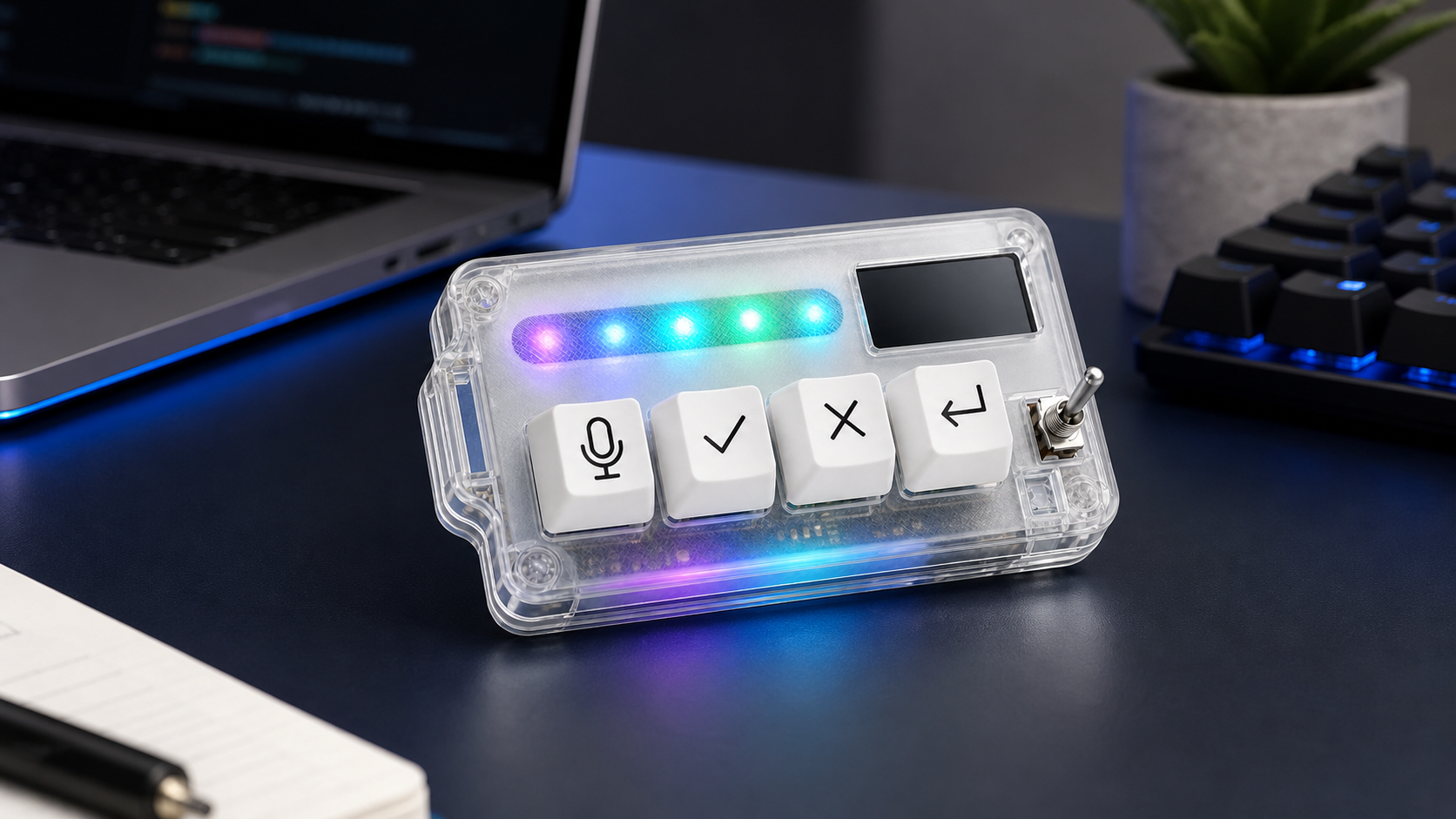
If the four actions are microphone, approve, cancel, and return, the hand learns them quickly. The device becomes less like a menu and more like a set of physical punctuation marks for the AI session. Speak. Yes. Stop. Next.
That small map is especially useful when the developer is reading generated code. During review, attention should stay on the output. A tiny keypad lets the hand perform common decisions without asking the eyes to find another control.
Desk reach matters more than key count
A full keyboard may have many available keys, but the most comfortable ones are already busy. Home row is for typing. Modifier chords require both memory and finger gymnastics. Function keys may be far away or missing on compact laptops.
A tiny keypad can sit exactly where the repeated workflow actions belong. Left of the main keyboard. Near the mouse. Beside a laptop. Under the hand that is not currently typing. That placement can make four keys more useful than forty hidden shortcuts.
The best location depends on the user. The test is simple: can you hit the control without looking and without disturbing your normal typing posture? If yes, the device is earning its space.
When a tiny keypad is the wrong choice
A tiny keypad is not always better. If you want dozens of labeled controls, app launchers, scene switching, media commands, and visual menus, a larger programmable device may fit better. If you love keyboard shortcuts and already use them without hesitation, another device might be unnecessary.
It is also the wrong answer if the AI workflow itself is unclear. Hardware cannot fix vague prompts, weak review habits, or lack of tests. If you do not know which actions repeat, wait before buying anything. Observe the workflow first.
A small keypad works best when the repeated actions are already obvious and the existing interface makes them slightly too hard to perform.
Why four keys can be enough for AI agent control
AI agent control often comes down to a small loop. Give the agent a better instruction. Approve a useful step. Cancel a bad direction. Continue the next turn. Four physical keys can cover that loop without turning the desk into another cockpit.
HarnessKeys follows that philosophy. It is a compact vibe coding keyboard with dedicated keys for microphone, approve, cancel, and return-style actions. It supports USB and Bluetooth, includes a custom status screen, uses an RGB light bar for quick feedback, and keeps the body small enough to sit near the main keyboard.
The full keyboard remains the center of development. The tiny keypad does not compete with it. It removes a few repeated AI workflow actions from the crowded main keyboard and gives them a dedicated place. For developers who work with AI agents every day, that small separation can feel surprisingly large. The HarnessKeys AI Workflow Keypad is built for that focused control lane.
